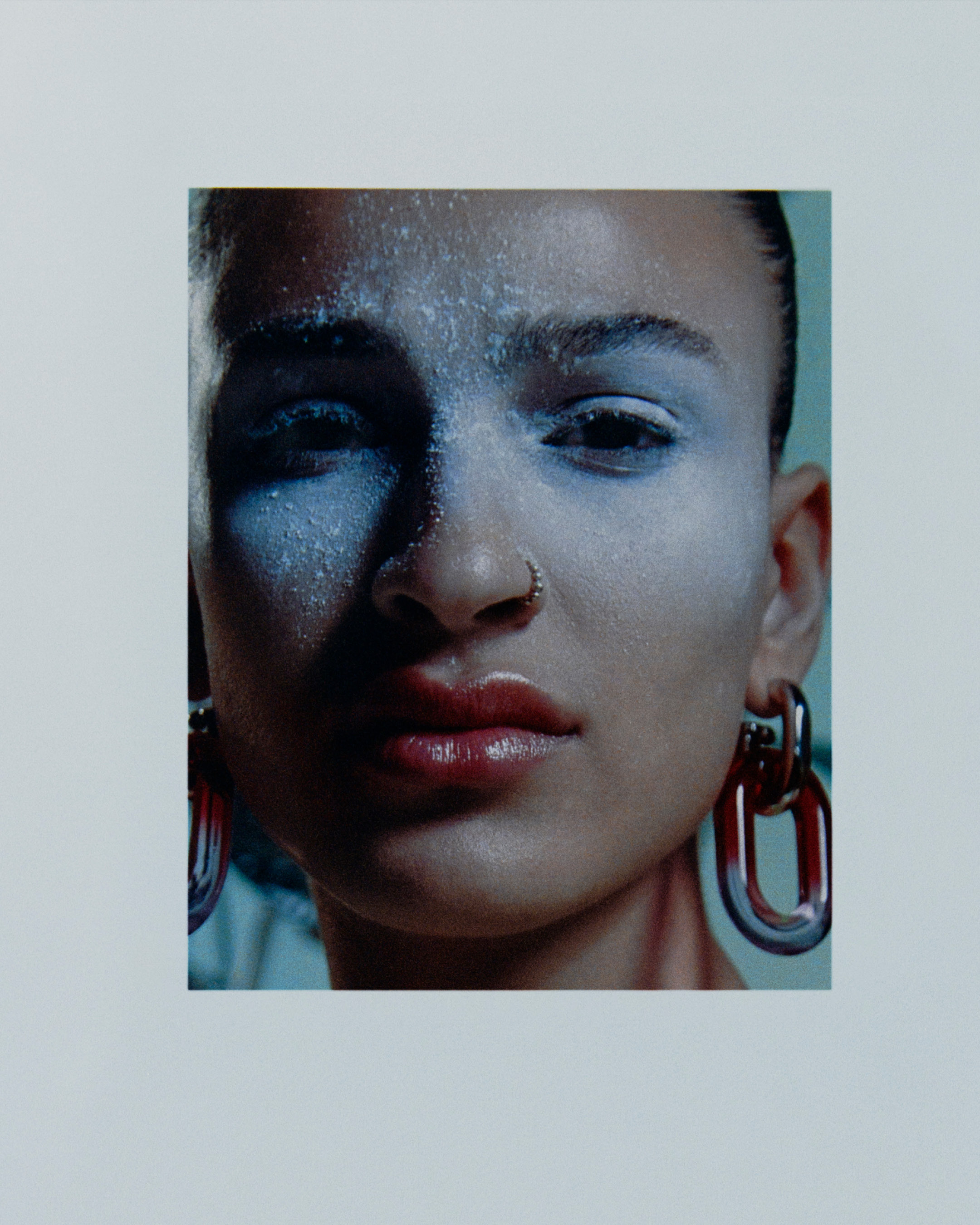
SECOND SKIN
“Shooting analogue feels almost ceremonial,” says Maja Johansson, a Stockholm-based photographer. For Faith Love Hope, she explored identity, leaning close to her models' faces and torsos and shooting from the hip up. Maja is motivated by curiosity, intuition, and a search for something fused with the real.
![]()
![]()
Rather than chasing perfection, she follows her gut, seeking the moments and details that create a feeling. Majas's method is spontaneous and collaborative, leaving room for ideas to evolve and the unexpected to become part of the image.
She is drawn to the relationship between colour, form, people, and environments, and to the shifts in atmosphere that can lift an image. In recent years, her work has increasingly explored where these elements meet the physical reality of sport.
![]()
![]()
On the process of shooting analogue, the medium used in this story, she shares: “Once you press the shutter, a certain presence emerges between the photographer and the person in front of the camera. It becomes more intimate,” Maja says.
“You also don't have as many chances when you shoot with analogue. Digitally, I could create a much broader range of material and then edit it down afterwards to find what belonged together.” She continues, “With analogue, the material is naturally more limited. Maybe that is part of why it feels less perfect as a whole, and why I like it. There is more room for something unexpected to remain.”
![]()
The editorial explores how we carry different versions of ourselves. I ask Maja whether it’s possible to hold on to your personality, or whether we are entering a time when most of what we consume is a moodboard, shaped by algorithmic trends.
“I definitely think clothes are still a way of expressing yourself creatively. But I also think they have become a way to construct a persona, a form of yourself you might want to be, or that fits a certain situation.
At least, that is how I think about my own relationship with clothes. Depending on the environment, the people I’m around, or the situation I’m entering, I choose certain materials, brands and clothes to create an illusion of confidence, humility, belonging, or sometimes I just want to disappear into the room.”
![]()
![]()
Maja is exploring the idea that identity may be less fixed than we like to think.


“Sometimes getting dressed is almost like choosing a version of yourself.”
The models she photographed for FLH convey something of themselves, even when styled. “Though we dressed a person in a very particular style, their personality still seemed to leak through as they tried to hold that more dressed-up façade.”
![]()
![]()
The styling in your story is unbiased, yet somehow this makes room for character. Is there a garment that hides a person best, and which one gives them away completely?
![]()
“That was the story's starting point: creating characters who could exist around us in everyday life,” says Maja. “People we recognise immediately, even if we don't know anything about them. I think a very carefully put-together look can sometimes hide a person best because it gives us too much information to read into. We immediately start filling in the gaps: who they are, what they do, what kind of person they might be. In that sense, the more complete the costume, the easier it can be to disappear behind it.”
At the same time, something always escapes a look's styling: the way someone holds themselves. That’s what I wanted to keep in the images: the tension between the character we construct and the person underneath.”
![]()
![]()
From the hips up only. What did you notice about the models when you could only see their torsos?
“I think limiting the body actually makes it harder to hide behind the clothes. When you remove the whole body- how someone walks, stands, or moves through a space- you are left with smaller details. A shoulder, a hand, the way someone sits, a slight change in expression.
![]()
And maybe that is where the person starts to reveal themselves. We spend so much time thinking about clothes as something that communicates who we are, but when you remove everything except the upper body, the styling almost becomes a frame.
You can control the clothes, the hair, the setting, but you have much less control over the small physical reactions that happen underneath. Those tiny things can completely contradict the character.”
![]()
![]()
Ok Maja, so you're sitting for a portrait. How would you dress and who would photograph it?
“My first instinct is that I don't know. I think I'd find it quite difficult to decide, because I would want to see how someone else interprets me rather than decide how I want to be seen.
It also makes me think about all the school portraits I've had taken over the years, and how much thought I put into what I wore for those photographs. Looking back, the clothes almost become little time stamps of who I wanted to be then, or who I wanted the people around me to think I was.
So perhaps I wouldn't choose the clothes myself. I'd rather let someone else dress me and see what they find in me. As for who would photograph it, probably someone who knows me well enough to see through whatever I put on.”
![]()
Going forward, Maja is excited to continue developing commercial and personal projects, from mountains and wild landscapes to an upcoming sports fashion project.
Alongside still photography, she is expanding into moving image and exploring new techniques in digital creation.


Photography Maja Johansson
Styling Olivia Bohman
MUAH Emike Szantos
Models Elsa | MIKA’s Jane, Tommy, Marion, Aaron | Nisch Mgmt
Words Johanna Engvall
Content Editor Magnus Swärd
Editor in Chief Sandy Kirik
READ MORE