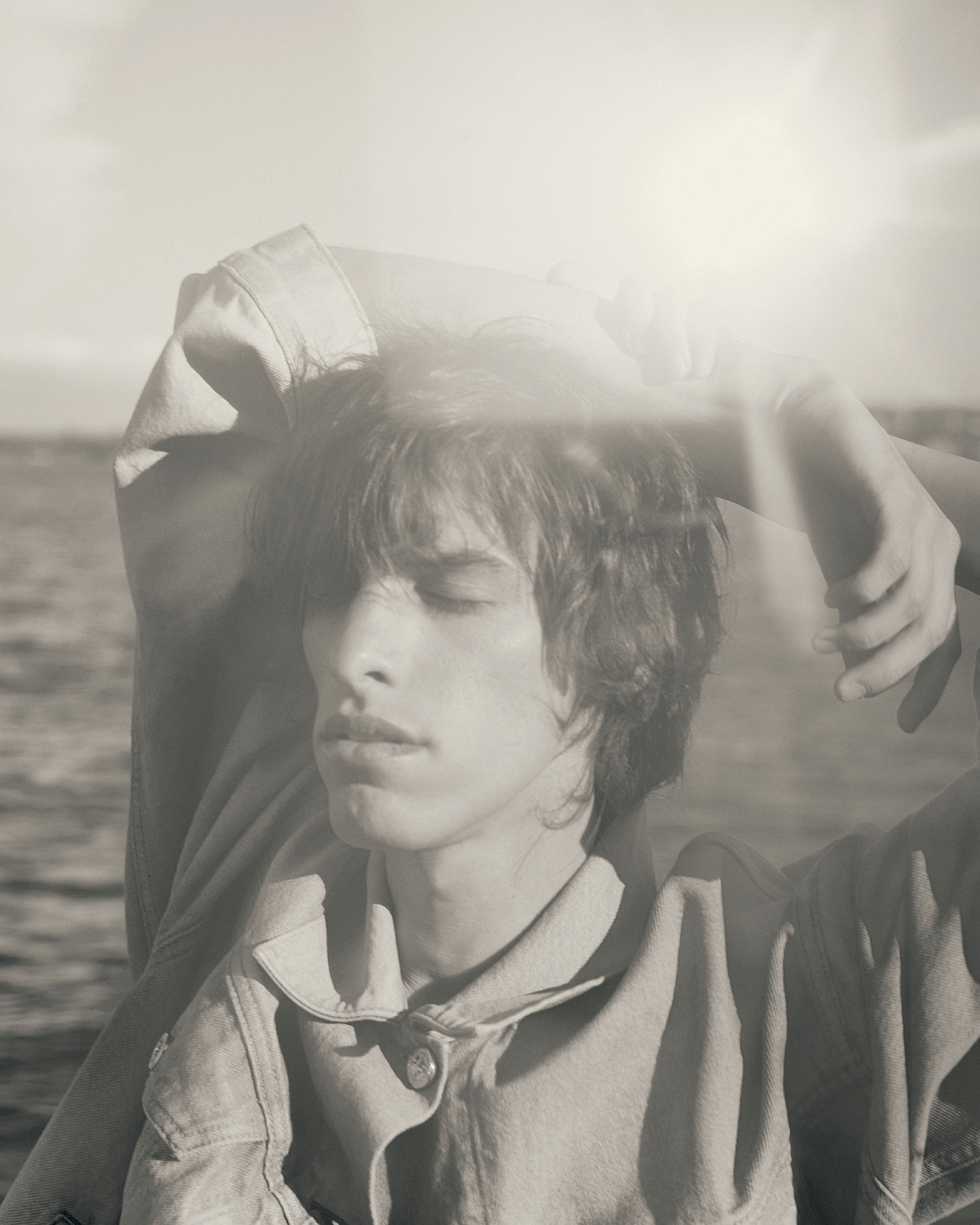
Amy Pollock
shows FLH how consistency, play and doubt make a multidiscplinary career fly.
![]()
![]()
FLH: You describe yourself as a Jane of all trades who thrives on either side of the camera. When you arrive on a new set, how do you decide which version will step forward first?
A: As simple as it sounds, I think the main thing that helps me decide is the call sheet. Whatever I am hired to do has to be my priority. But that said, I feel like the same version of me turns up regardless of whether I am acting or working crew. No matter what, I will always want to be in the action with the team. The main shift that I have to make when I am there as an actor is that I always keep aware of what is coming next in terms of performance. I keep a foot in the energetic door to the character, scene or narrative in some way or another to keep warm and connected to the work until we are wrapped. Scenes sometimes need more preparation, focus and space, but when I am not preparing to work, I love being with the crew.
I am very lucky to have spent so much time in front of the camera and behind the scenes, as it has allowed me to feel at home and develop a holistic understanding of set. This has made it easier to offer an extra pair of hands in different departments if needed, and I am always keen to help where I can.
FLH: You’ve mentioned that people have been on your case to “pick one profession.” What has kept you committed to this multidisciplinary life, and has that choice sharpened your craft as an actor and musician?
A: I am really grateful that I am able to do what I love and the freedom that comes with it. The lack of consistency and stability can be really hard at times, but I am incredibly fortunate to have people around me who inspire me every day. I am in awe of my incredible friends, family and community and feel very lucky to have them, especially when things get tough.
I have been a multidisciplinary creative for a very long time and find that having multiple things to work towards really helps me stay motivated if something starts to feel stagnant. Leaning into the flexibility and creative flow helps keep me inspired and moving, while I also love getting obsessive about learning new tools to expand my skill set.


“While working in the creative world, I am pretty used to hearing no or not getting a response. The resilience that has come from that has helped me pivot really fast and find ways to move forward in ways I never expected.”
Many opportunities have come from pushing myself out of my comfort zone into different disciplines, and honestly, learning across multiple disciplines has helped me improve my understanding of my work in all areas. It has helped me get an outsider perspective of my disciplines and has helped me fill in the gaps that would have been left open if I had not learned from multiple angles. The industry is incredibly fast, and giving myself the tools to navigate in different worlds has given me the ability to move with it.
![]()
FLH: What do you recommend to anyone who has the possibility to explore the same path?
A: You just have to commit, do it because you love it, fall in love with whatever it is you want to do and get obsessive, learn as much as you can and give yourself the tools to be self-sufficient. Know your craft inside and out, have fun and just love the crap out of it! Keep focused and don’t miss the opportunities that might present themselves to you. Do it because you can’t imagine yourself doing anything else.
FLH: Working across your fields, what have you learned about the process of getting a project over the finish line that you wish more people understood when they see the final 3-minute clip or 30-second spot? To step beyond the tip of the iceberg, so to speak.
A: Any project you see has so much time, preparation, and incredibly hard-working teams (some who have spent their whole lives dedicated to their craft) behind it. As a creative, you go through so many waves of doubt, love, hate, excitement, burnout, passion and stress to get things from the first idea to the end product. The finished product is only the tip of the iceberg, and there are so many more projects out there that never get across the finish line.
At the moment, arts budgets are getting cut, people are not getting paid what they are worth, projects are coming out of the creatives' pockets, and it’s a struggle to get work seen and heard. If you see your friends making any form of art, please support them! Watch it, listen to it, buy it, go to their shows, tell your friends about it; even just a small interaction online with their work can help make a huge difference.

“I think with everyone being so focused online and with the normalisation of ‘content’, artists aren’t able to just be artists anymore.”
We have to be marketing geniuses, social media managers, agents, content creators, etc, so please support your beautiful artist friends and the artists you love. It’s a heavy load to create in a content-heavy culture, and we need the arts now, more than ever.
FLH: You’ve spoken about the “team sport” of creativity. Can you share something from a recent shoot when that sense of connectivity changed the outcome of the work?
A: I worked on a really beautiful short, White Lines, directed by Ollie Ivin-Poole, which was shot on film. From the very beginning, there was much care taken in making it. My co-star, James Fraser and I had wonderful, natural chemistry from the second we met, which is always such a gift as it makes the work fluid and trust can be built very quickly.
We explored the characters through improvs, rehearsals, coffee meetings and a session with our intimacy coordinator, Natalie Ivin-Poole. Though we didn’t have a huge amount of time, by taking care with the fundamental blocks of character building as a team, we were able to create more layers to our performances and the film.
We built trust quickly and worked with the crew who facilitated a safe environment on set for us to do our work. There were some specific scenes where I needed to be quite vulnerable and access heightened character moments, which required preparation.
Through this process, Ollie and I developed a shorthand that enabled us to communicate in a language we both thrived in and explore ideas we had not planned for. If you have trust, play and patience in the creative world, you can elevate your work beyond what you planned for; it just gives you the freedom to freely create.
![]()
![]()
FLH: You were injured shooting a commercial and finished the job anyway. What did that reveal about just how far you are willing to go to complete a project? Note: What are your recommendations for checking in on professional and personal boundaries?
A: It was a pretty high-pressure job with a lot of moving parts, which I was really excited to be part of. I am a very physical person and am used to pushing my body, so the mix of that and my stubborn commitment got me through, despite the injury.
Only a select few people knew about the injury as I didn’t want it to be made into a big deal with additional attention on me. The people who knew were incredible in looking after me as best they could and never put pressure on me to finish. I think if there was outside pressure for me to continue, I would have very different feelings towards it, but I was supported the whole way by the wonderful team. Ignoring the pain and extensive tears, I had so much fun on that shoot.
I am used to pushing myself, and that is something I am very aware of. I have definitely developed an understanding of what my boundaries are and continue to learn about them. Working in the creative world, you really need to learn what your value is and what is important to you. I think, for any form of boundary, you need to trust your instincts. You have to check in with your energy and know if something is fuelling you, draining you or making you uncomfortable. Whatever it is, you need to trust that feeling and learn how to vocalise it as soon as you can. Your energy and time are precious resources that you have to protect at all times. If you are unsure, talk to someone you trust to get clarity, support or a second opinion, but never ignore that voice in the back of your head.


“At the end of the day, your boundaries are personal to you, and it’s as simple as that. Never hesitate or be scared to vocalise how you are feeling.”
FLH: In a moment where AI is everywhere, you’ve voiced for people to “get back to basics” and be comfortable with “sucking” at something for a while. How are you personally protecting play, making mistakes, doubt and imperfections in your work right now?
A: AI just makes me sad. It is incredibly bad for the environment and is encouraging people to reduce how much they use their brains. It’s taking away the resilience it requires to learn something new and is reducing the understanding of the reality of the time commitment and patience it takes to master a craft. (Especially in the creative world)
Everyone has the opportunity to nourish their individual voice, but by using AI, everyone will lose their individuality by taking from the same pool of data, while also stealing from artists' original works and voices.
I want people to see how beautiful mistakes are and how beautiful individuality is. I want people to know how good it feels to nail something after you worked long to master a skill or a craft. There is something really rewarding about seeing progress in your work, but it takes patience, time and resilience to keep working through the ‘I suck’ stage.
I am feeling rebellious against the AI world, and it is pushing me into wanting to exist in the tactile world even more. I am craving play, human connection and art. I am knuckling down with my crafts, keeping warm in my acting training, putting energy behind getting more projects off the ground, teaching myself new guitar/piano/saxophone techniques along with mucking around on other instruments for fun, teaching myself how to write and direct for screen and learning music production. I am trying to push myself out of my comfort zone as much as I can. I am getting used to not knowing what I’m doing and doing it anyway while trusting the process. I am also collaborating with new creatives while trying to facilitate energetic spaces where we can just lean into play. The freedom of that helps get new ideas going and allows me to take risks when creating.
I am trusting my instincts more in acting and music while not comparing my choices to anyone else’s. Happy accidents are often what make us special, and that’s what I want to see when I am watching actors and musicians work. I want to see their choices, their voices, not mine, and not anyone else’s, theirs. We aren’t going to get new stories by living in a digital world. Play and human connection in the real world is the whole point; without it we will lose touch with what is important.
“I am finding myself embracing my scrappiness and mistakes because I don’t want perfection anymore; I want real things.”
![]()
FLH: How do your different roles communicate with each other, and where do your artistic vocabularies overlap?
A: I think that switching between acting, music, and other work with creatives helps keep my creativity in flow. Sometimes I can feel blocked or creatively rinsed in one area, and being able to switch to another project can help move my energy quickly to get me out of my head. For acting and music, once I am performing or writing, I am in my body; I can lock in, and I don’t think about anything else except for what is in front of me, and it’s so freeing. When I am in creative flow, I feel like my nervous system is calm, I feel present, and that’s when everything comes, as long as I trust it.
I feel like helping others with their creative projects helps me switch from flow into structure. When you are in charge of your own creative path, sometimes you can’t see two steps in front of you; that’s why having people around you whom you can trust is worth everything. I find it so easy to see other artists clearly and see their beauty and what they bring to the world. But for my work, I find it difficult sometimes. So it’s nice to have that clarity for others and gives my creative brain a break to come back and tackle my work with a fresh perspective.
Coming from a multidisciplinary background, I have gained an understanding of how to communicate effectively with people from a lot of different disciplines and worlds. It is important to understand that not everyone communicates in the same way, and it is important to navigate that in order to connect and create.
I feel that my voice changes depending on the project, but there is always a little bit of me in everything I do. The overlap is the process I take to create; it all comes from instinct, trusting my gut and is grounded through my body. My work can vary from dark and serious to being quite silly and weird, to being scrappy with some strange whimsey at times. But no matter what, it always comes from a grounded place.
![]()
FLH: What draws you to a visual or sonic world enough that you want to not only appear in it, but also help build it from the ground up?
A: There is just something really special about how ideas are conceptualised, from being nothing to having the opportunity to develop a whole new world. I have always had a really strong visual imagination and feelings towards how I see projects in my mind. The more I make and work on, the more I trust my instincts. I have also been getting more confident in vocalising and trusting my ideas, which is a huge hurdle I am continuing to work on.
I love the challenge and the process of finding something visual that sits with a sonic world. Sometimes an idea won’t click, or it feels sticky, and I am learning to trust that just means the right idea hasn’t come yet. But when something does click, it is the best feeling because I know I’m on the right path. It’s really fun to work with a team on a joint vision for a project. Collaborative relationships are special, and I adore seeing projects come to life, with all the little happy accidents on the way. I love working with the Creature Fear crew, as their music and energy inspire so many ideas that I adore making. We have made some really fun things together, from music videos to stop motion animations.
While being part of projects visually, I just think of myself as a piece of the puzzle, see the project as a whole and focus on how I can serve the narrative, visuals or story. I try not to think about it too much to avoid getting in my head and just focus on the work because that’s what I really love.
FLH: Thinner Than Water marked your official theatre debut. What did the comeback to the intimacy of stage work show you about presence and stamina that you now carry back into your screen work?
A: Being on stage is initiation by fire. As soon as I started the process, I was terrified, especially while co-producing at the same time. I doubted every reason why I said yes and doubted every choice I made, but that all went away as soon as I was on stage. Stage acting is so alive; you have to listen, work as a team, troubleshoot on the fly and most importantly, you just get to play. On screen, you don’t usually get to play with the work to the extent you do in theatre because of the logistics and technicalities of making a film. But with theatre, you have a chance to be free when you are up there; your acting muscles and focus get so much stronger so quickly because you are actively working for such extended periods. Once the show has started, it’s just you and your acting partners, and you can’t stop; it's terrifying and thrilling at the same time. That’s what I will always want to bring to my screen work: the electricity you get from being present and being in the moment with the person in front of you.
I was so lucky to work with my brilliant friend Tim Williams as our director, our incredible team of actors who I have always hugely admired, and the crew. Theatre can be really special if you are fortunate to have a team as we did, and I didn’t want it to end.
![]()
FLH: You have mentioned that you wish people experience creativity in its “purest, unfiltered form”. When you imagine the next few years, what does a genuinely sustainable, humancentred career in the arts look like for you?
A: I just really want to make sure I am doing something every day that makes me happy, and that helps me feel connected to my creativity, play and work. I want to keep pushing myself out of my comfort zones by training and taking on stories or projects I need to work hard for. I want to make sure I am continuing to create new works and not just waiting for projects to come my way.
Over the next few years, I am really excited to collaborate with some new creatives and have some upcoming acting projects I am very keen to explore, along with a few scripts I am working on to get to the next stages of production. I also have some new songs which I will be releasing soon and am starting to plan getting back into the studio, which is exciting. I am in the very early stages of planning some more time overseas to play and collaborate with some beautiful creatives and am excited to keep expanding my network and inspirations.
I will be keeping focus on making sure my muscles are staying warm with acting, playing music, collaborating, writing, mentoring, performing shows, making film, getting on set as an extra part of hands, embracing tactile environments, community and staying open to opportunities.
The main things that sustain me are the wonderful people who come into my life and staying connected to play and silliness. I just want to keep creating with wonderful people. We are only here for a short amount of time, so we may as well do the things we love with the people we love. Honestly, I feel like I am figuring it all out as I go. The timing of things is always funny, but it always works out, even if it’s not in the way you expected.
Thank you, Amy, for your heartfelt contribution to creative endeavours and Faith Love Hope Magazine!


Photography Stephanie Cammarano
Styling Charissa Trikos
MUAH Rob Povey
Talent Amy Pollock
Words Johanna Engvall
Layout Tove Wall Dyrting
Content Editor Magnus Swärd
Editor in Chief Sandy Kirik
READ MORE